General
What is REMIT?
REMIT is the title of Regulation (EC) No 1227/2011 of the European Parliament and of the Council on wholesale energy market integrity and transparency, which provides a coherent European regulatory framework specific to wholesale energy markets. As such, it is defined and implemented:
- Prohibition of insider trading
- Obligation to publish inside information
- Prohibition on Market Manipulation
- Monitoring of Wholesale Energy Markets
More information you find at REMIT page.
Is REMIT reporting mandatory?
REMIT applies to any energy market participant. It means everyone who participates in the one or more wholesale energy markets within the Union is required to report according to REMIT. In ACER’s opinion, it makes no difference whether these individuals live in the EU or are professional investors. Furthermore, REMIT applies to non-EU and non-EEA market participants when entering into transactions on one or more wholesale energy markets within the Union.
What does “Inside Information” mean?
In accordance with Article 2 of the REMIT, “inside information” means information with the following elements:
- is of a precise nature.
- has not been made public.
- relates, directly or indirectly, to one or more wholesale energy products.
- if made public, it would be likely to significantly affect the prices of those wholesale energy products.
Art. 2 also makes it clear that inside information includes:
– information about the capacity and use of facilities to produce, store, consume or transmit electricity or natural gas, or information related to the capacity and use of LNG plants, including the planned or unplanned unavailability of such plants;
– information on the transparency obligations defined in EC Regulation 714/09 and Regulation 715/09;
– information with the above characteristics, which the participants should publish in accordance with regulations, rules and contracts;
– any other information that a reasonable market participant will use as a basis for its decisions.
Is there an obligation to publish Inside Information on platform?
Since 01.01.2021 the REMIT market participants should publish inside information about IIPs. The own website may still be used and indicated in the registration, but this does not replace the use of the IIP as the primary publication platform for inside information.
If market participants assume that they do not possess insider information that is subject to disclosure, they do not need to register with an IIP. In this case, “na” (not applicable) must be entered in the national register. It is the responsibility of each market participant to verify the existence of this requirement.
What are the market participants’ obligations in relation to Inside Information?
According to Art. 4 REMIT, market participants are obliged to effectively and timely disclose to the public the inside information they have about the companies or facilities owned or controlled by the respective market participant, the parent company or an enterprise related to it, or for operational issues of which the market participant or enterprise is wholly or partly responsible. This requirement may be met even if the publication is in aggregate form. In its Guidelines, ACER highlights the use of centralised platforms for the publication of inside information.
About Webware IIP
Is it necessary to conclude a contract to publish inside information?
Yes, market participants wishing to use the IIP publication service must conclude a standard contract regulating the rights and obligations of the parties in relation to the use of the IIP by filling out the relevant web form and completing the process of filling out and signing the contract.
How do I register to become a publisher on the REMIT Inside Information Platform?
To get access to the Inside Information Platform, please register on the portal or send a
request to our customer service: support@inside-information.de
Phone: +49 (0)561 56014565
Do we need any additional software?
The user has possibility to manage the information and publish UMM via a web interface. So no additional software is needed.
Also we have developed a SFTP and API interface. With this interface you have the possibility to automate the transfer of UMM. Ask for our documentation for SFTP and API interface.
What are the technical requirements needed to use the SFTP and API interface?
Webware has prepared an IIP user guide that describes all communication protocols and technical specifications required for proper access and use of the platform. The manual is published on the REMIT IIP website.
Reporting of Inside Information
What information can be published on the platform?
Market participants may provide information on the capacity and use of facilities for the production and storage, consumption or transmission of electricity or natural gas or the capacity and use of LNG facilities, including planned or unplanned unavailability of such facilities.
Is the publication of inside information limited to the German market only?
No. Market participants can publish information about any “bidding zones” of the European electricity or gas market by entering the EIC code in the corresponding column.
Should a standard format be prepared for uploading inside information that will be published?
The user has possibility to manage the information and publish UMM via a web interface. So no additional software is needed.
For automated SFTP and API transfer Webware will provide a standard format according to which participants should upload their inside information. This format will be based on the content and formats specified by ACER in its guideline.
We have no inside information. What are we supposed to do?
If market participants assume that they do not possess insider information that is subject to disclosure, they do not need to register with an IIP. In this case, “na” (not applicable) must be entered in the national register. It is the responsibility of each market participant to check whether this prerequisite is met.
Definition & disclosure of inside information
What counts as “information”?
Under REMIT, “information” also covers planned or unplanned changes in capacity or output at facilities related to production, storage, consumption, transmission, and LNG.
Inside information criteria
- Precise in nature
- Not publicly available
- Related to wholesale energy products
- Would significantly affect prices if public
Disclosure requirements
- ACER expects inside information to be disclosed through an Inside Information Platform (IIP).
- Publication on a website or social media can supplement but does not replace IIP disclosure.
How the Assets are determined?
- An Asset in the energy market refers to a physical or organizational unit involved in energy generation, storage, transmission, or distribution, such as power plants, solar farms, wind turbines, storage facilities, or network infrastructure.
- The EIC Code (Energy Identification Code) is a unique identifier assigned to each asset, such as a power plant or wind farm. This code ensures that the asset can be clearly identified and linked to relevant data for reporting and market transparency purposes. It includes the EIC W, T or Z code of the facility that is unavailable.
In case of an asset being unavailable (e.g., during an outage), the EIC Code of the affected asset must be identified at the most granular level. For example, if a production unit is made up of multiple sub-units, the EIC of the relevant sub-unit should be reported.
What is an EIC Code and what types exist?
- An EIC Code (Energy Identification Code) is a unique identifier used in the energy sector to clearly mark various participants and facilities in the energy market. The EIC code helps identify market participants, energy generation plants and transport systems.
- For asset identification, only the W, T and Z codes are allowed:
-
- W-Code
Used for generation units, such as power plants or wind farms. Identifies the energy source that produces electricity or other forms of energy. - T-Code
Used for transmission units that transport energy through networks, such as power lines or gas pipelines. - Z-Code
Used for other market participants, such as consumers or market platforms — also for non-functional entities that do not directly perform generation or transport functions.
- W-Code
-
When should the EIC code of an individual wind turbine be used, and when should the EIC code of the entire wind farm be used for reporting Inside Information?
- Use the individual wind turbine’s EIC code if the failure of that turbine significantly impacts the market (e.g. a high-capacity turbine).
- Use the entire wind farm’s EIC code if the failure affects the whole farm or its total generation capacity.
This applies when all turbines are affected, or the failure impacts total generation capacity, allowing for an aggregated report.
If I operate multiple solar parks, can I submit an aggregated report, or do I need to report each park separately?
- If you operate multiple solar parks, the general rule is that each individual solar park should be reported separately as a distinct Asset. Each solar park typically has its own EIC code, and reporting must be done for each park based on its specific data, such as availability, capacity, and any unavailability or inside information.
- However, if the individual parks do not have significant market relevance on their own, but the aggregated capacity of all the parks collectively has a market impact (for example, if the combined capacity of the solar parks is large enough to influence the market), you may choose to report the aggregated capacity as a single Virtual Power Plant (VPP) with a single EIC code.
In this case, the VPP can be treated as one asset for reporting purposes. This is particularly useful when the total capacity of the parks is market-relevant, but the individual parks do not individually affect the market.
Summary:
- Separate reporting is required for each solar park if each park has its own EIC code and is market-relevant.
- Aggregated reporting can be used if the combined capacity of the parks is market-relevant, and you can treat the group of parks as a single VPP asset with one EIC code.
See Question § 4.1.18 REMIT Frequently Asked Questions (FAQs): On REMIT fundamental data and inside information collection (V8 – 26 March 2026)
What is the Minimum Facility Capacity for Reporting Inside Information?
- ACER has not defined a specific minimum value in megawatts for when information about a facility must be reported. Instead, ACER provides general guidelines.
- The agency requires that information about a facility must be reported if it constitutes “Inside Information” – that is, if it could potentially have a significant impact on the prices of related wholesale energy products.
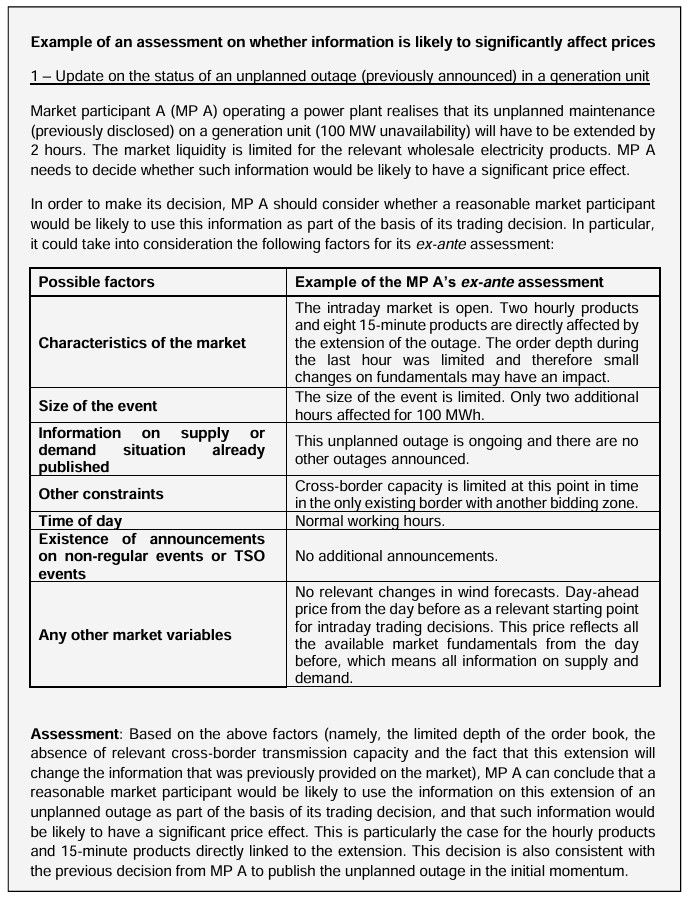
- However, ACER provides factors to consider when assessing the relevance of information, such as the size of the event, the market situation, and other relevant market variables. The responsibility for determining whether information must be reported lies with the market participant, who must assess the likelihood of a significant price movement based on the information.
For more information please see:
§3.3.4
Information is deemed to constitute inside information only if, were it made public, it would be likely to have a significant effect on the prices of related wholesale energy product. Based on the condition of a significant price effect, the Agency narrowed the wide notion of information down to the information that is crucial enough to have the potential to significantly affect the prices of wholesale energy products, and therefore to information that is relevant for trading.
The assessment of the likelihood of price effect has to be performed by a market participant on a case by-case basis.
The market participant should take into consideration the anticipated effect of the information in light of the nature of the information, as well as the specificities of the market and the market situation at the time of the assessment.
A non-exhaustive list of factors that are typically relevant for this assessment are provided below:
- the characteristics of the market (size, timeframe, market design, liquidity, type of participants etc.);
- the size of the event;
- the already published information on supply or demand situation;
- availability and unavailability of transmission facilities, storage or network constraints;
- the time of day (e.g. weekday/weekend, office hours/out of office hours);
- the existence of announcements on non-regular events (for example, the commissioning of new power plant, the re-commissioning of mothballed power plant, etc.);
- TSO announcements related to the system (imbalances, security of supply, technical constrains etc.); and
- any other market variables likely to affect the price of the related wholesale energy product in the given circumstances (e.g. weather conditions, CO2, fuel prices, news on political and geopolitical developments etc.).
For a better understanding of the difference between the publication of Inside Information and ACER REMIT Reporting, please see the answer to the following question: :”What is the Minimum Facility Capacity for ACER REMIT Reporting?”
What is the Minimum Facility Capacity for ACER REMIT Reporting?