Webware Inside Information Platform
When do you need to publish an outage under REMIT? Find out how to assess an event, identify the affected unit and publish an Urgent Market Message (UMM) through an Inside Information Platform (IIP).
How do I identify the affected asset and its EIC code?
An Asset in the energy market refers to a physical or organizational unit involved in energy generation, storage, transmission, or distribution, such as power plants, solar farms, wind turbines, storage facilities, or network infrastructure.
The EIC Code (Energy Identification Code) is a unique identifier assigned to each asset, such as a power plant or wind farm. This code ensures that the asset can be clearly identified and linked to relevant data for reporting and market transparency purposes.
In case of an asset being unavailable (e.g., during an outage), the EIC Code of the affected asset must be identified at the most granular level. For example, if a production unit is made up of multiple sub-units, the EIC of the relevant sub-unit should be reported.
For asset identification, only the following codes are allowed:
- W identifies a resource object, such as a generating unit.
- T identifies a tie line.
- Z identifies a measurement point.
In its March 2026 update to Annex VII, ACER made the affected asset or unit EIC mandatory in the applicable unavailability schemas and added support for substation codes. ACER gives market participants until December 2026 to implement the update.
ACER update on Annex VII and field 17 · ENTSO-E EIC functions and definitions
What is an EIC Code and what types exist?
- An EIC Code (Energy Identification Code) is a unique identifier used in the energy sector to clearly mark various participants and facilities in the energy market. The EIC code helps identify market participants, energy generation plants and transport systems.
- For asset identification, only the W, T and Z codes are allowed:
-
- W-Code
Used for generation units, such as power plants or wind farms. Identifies the energy source that produces electricity or other forms of energy. - T-Code
Used for transmission units that transport energy through networks, such as power lines or gas pipelines. - Z-Code
Used for other market participants, such as consumers or market platforms — also for non-functional entities that do not directly perform generation or transport functions.
- W-Code
-
Some examples of reporting
When should the EIC code of an individual wind turbine be used?
- Use the individual wind turbine’s EIC code if the failure of that turbine significantly impacts the market (e.g. a high-capacity turbine).
When should the EIC code of the entire wind farm be used for reporting Inside Information?
- Use the entire wind farm’s EIC code if the failure affects the whole farm or its total generation capacity.
This applies when all turbines are affected, or the failure impacts total generation capacity, allowing for an aggregated report.
If I operate multiple solar parks, can I submit an aggregated report, or do I need to report each park separately?
- Betreiben Sie mehrere Solarparks, müssen bei einem veröffentlichungspflichtigen Ereignis die jeweils betroffenen Anlagen eindeutig identifiziert werden. Bezieht sich eine öffentliche UMM auf mehrere Anlagen, muss sie für die Datenerfassung nach Anlagen aufgeteilt werden, wenn das verwendete Meldeschema nur eine Anlage je Nachricht zulässt. Bei Ereignissen, die zahlreiche Anlagen betreffen, beschreibt ACER auch die Möglichkeit einer Meldung im Schema „Other market information“. www.acer.europa.eu
- Werden Anlagen als virtuelles Kraftwerk (VPP) im Regelenergiemarkt betrieben, kann ihre gemeinsame Nichtverfügbarkeit marktrelevant sein. Abhängig von der Ausgestaltung des VPP kann eine veröffentlichungspflichtige Information über das Schema „Other market information“ bekannt gegeben werden. Im Bemerkungsfeld sind alle relevanten Angaben einschließlich des betroffenen Regelenergieprodukts einzutragen. www.acer.europa.eu
ACER-FAQ 4.1.18 zu virtuellen Kraftwerken · ACER-FAQ 5.1.8 zu Ereignissen mit mehreren betroffenen Anlagen
Which event type applies to an electricity storage outage?
ACER gives an electricity storage outage as an example of Other unavailability in the Type of Event field when the other available categories do not describe the event accurately. Use this classification if the event qualifies as inside information and that option fits the outage.
What is the Minimum Facility Capacity for Reporting Inside Information?
- ACER has not defined a specific minimum value in megawatts for when information about a facility must be reported. Instead, ACER provides general guidelines.
- The agency requires that information about a facility must be reported if it constitutes “Inside Information” – that is, if it could potentially have a significant impact on the prices of related wholesale energy products.
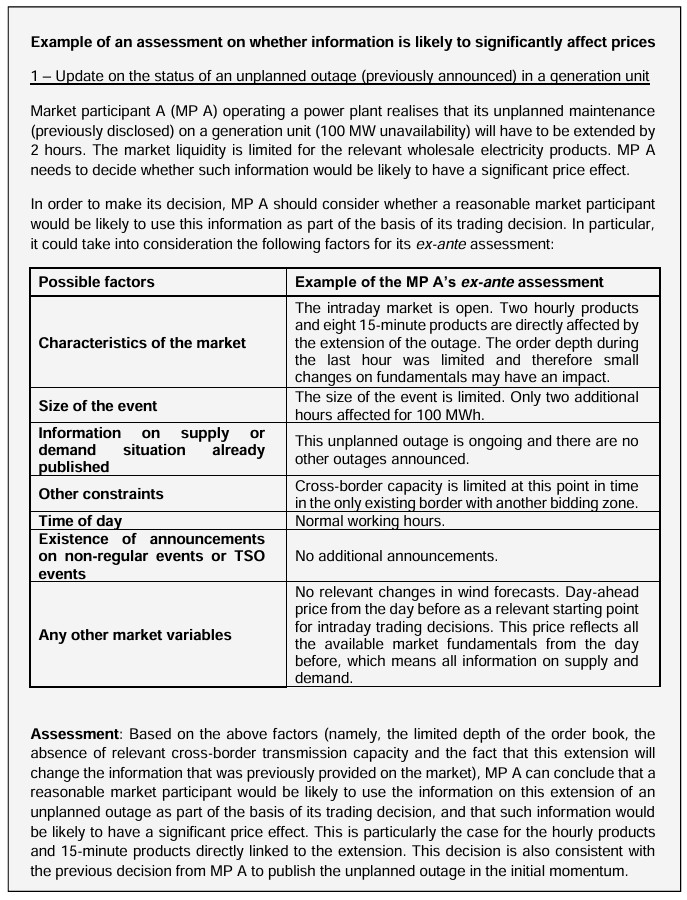
- However, ACER provides factors to consider when assessing the relevance of information, such as the size of the event, the market situation, and other relevant market variables. The responsibility for determining whether information must be reported lies with the market participant, who must assess the likelihood of a significant price movement based on the information.
For more information please see:
§3.3.4
Information is deemed to constitute inside information only if, were it made public, it would be likely to have a significant effect on the prices of related wholesale energy product. Based on the condition of a significant price effect, the Agency narrowed the wide notion of information down to the information that is crucial enough to have the potential to significantly affect the prices of wholesale energy products, and therefore to information that is relevant for trading.
The assessment of the likelihood of price effect has to be performed by a market participant on a case by-case basis.
The market participant should take into consideration the anticipated effect of the information in light of the nature of the information, as well as the specificities of the market and the market situation at the time of the assessment.
A non-exhaustive list of factors that are typically relevant for this assessment are provided below:
- the characteristics of the market (size, timeframe, market design, liquidity, type of participants etc.);
- the size of the event;
- the already published information on supply or demand situation;
- availability and unavailability of transmission facilities, storage or network constraints;
- the time of day (e.g. weekday/weekend, office hours/out of office hours);
- the existence of announcements on non-regular events (for example, the commissioning of new power plant, the re-commissioning of mothballed power plant, etc.);
- TSO announcements related to the system (imbalances, security of supply, technical constrains etc.); and
- any other market variables likely to affect the price of the related wholesale energy product in the given circumstances (e.g. weather conditions, CO2, fuel prices, news on political and geopolitical developments etc.).
For a better understanding of the difference between the publication of Inside Information and ACER REMIT Reporting, please see the answer to the following question: :”What is the Minimum Facility Capacity for ACER REMIT Reporting?”
Publish your UMMs with Webware IIP
Contact us to set up your assets and publish inside information through our IIP. We support publication via the web portal, API and SFTP.